Start with love - Make room at the table
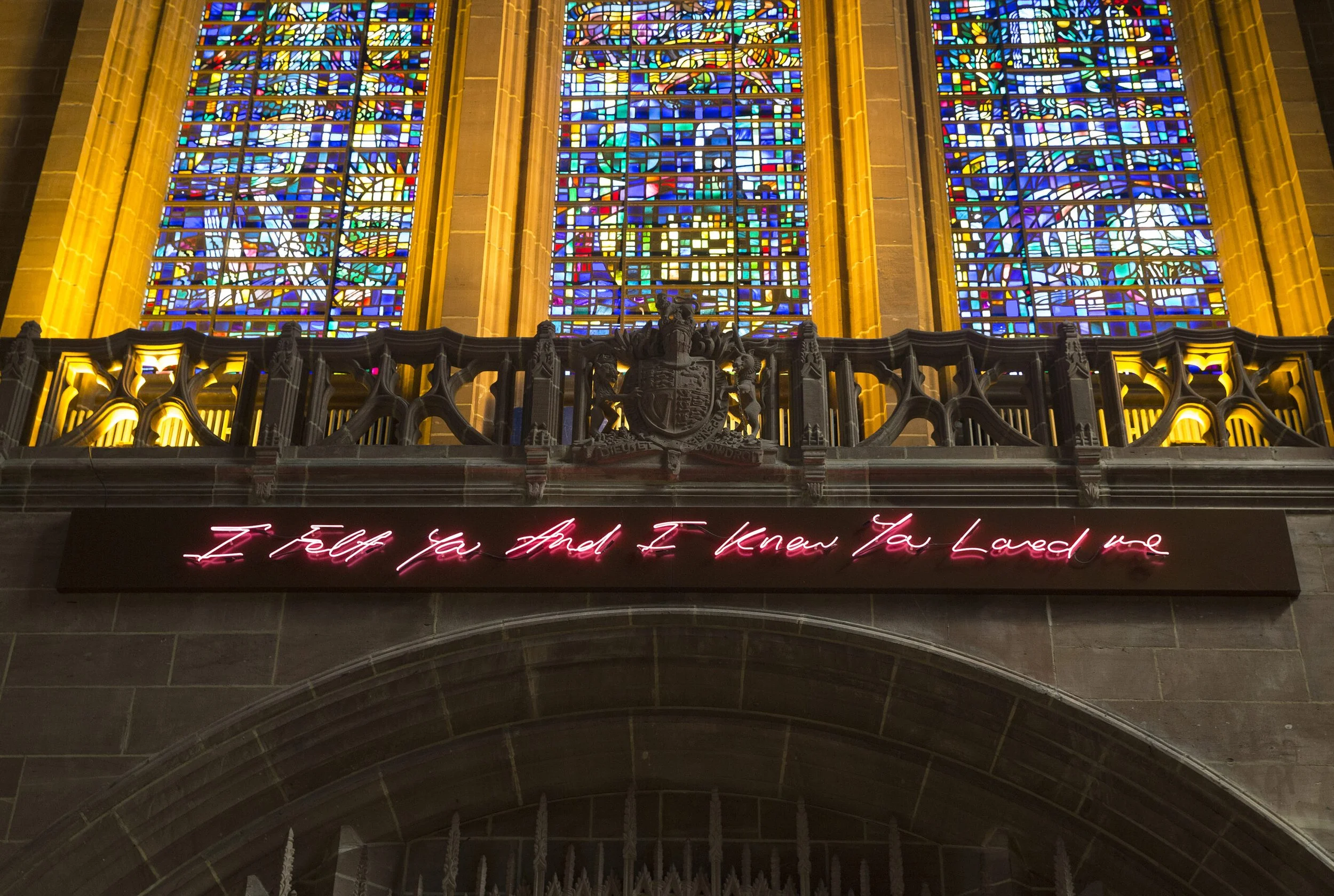
Tracey Emin’s For You neon light installation, below the west window of Liverpool Cathedral (the biggest Cathedral in Britain and the fifth largest in Europe.). The work, in pink neon, reads ‘I felt you and I knew you loved me’. PHOTO: Livepool Cathedral.
LIFE is incredibly tough for so many people at the moment. We all need access to psychologically (and physically) safe spaces where we can feel loved unconditionally.
The Open Table Network’s Funding & Governance Advisor Sarah Jones argues that this should be the primary role of the local church.
Where church falls short of this, that’s why Open Table communities where LGBTQIA+ people are not just welcomed but truly belong are needed.
Whatever faith you do or don’t have, I believe that you should be able to walk into your local church and know that first and foremost, you are loved.

Sarah Jones grew up in the Anglican Church and has volunteered with church and community projects since she was a teenager. She has worked in and with the voluntary sector throughout her life, including 14 years as Chief Executive of a local learning disability charity. She first became involved with Open Table Liverpool in 2010, when she came out as bisexual. In 2019 she helped lead the process of Open Table Network becoming a charity, and since March 2024 she has been providing support to OTN on a freelance basis, around funding and governance. WATCH: Sara’s intro video [2mins].
“It’s our job to make room at the table, so everyone feels welcome”
This for me, is why churches should have tall steeples, I want everyone to have a visual reminder that there’s somewhere they can go and ‘belong.’ Yes, as a Christian and a big fan of architecture, I love beautiful buildings (especially old churches) and I see the expert craftmanship as way of glorifying God. But just as much, I see it as a visual reminder of arms spread wide on the cross and the arms of God open and waiting to wrap me up in a big, long, warm hug.
I firmly believe that knowing there is somewhere nearby where you can be welcomed and celebrated and loved is incredibly important for our mental health. Whether or not you ever chose to cross that threshold, knowing that it’s available to you has a protective effect on our wellbeing.
On the flipside, if that steeple is a daily reminder of rejection, that can be hugely harmful. It adds to a compounding sense of isolation. And it doesn’t just harm LGBTQIA+ folk - it harms anyone who feels different, anyone who’s felt pressure to conform in order to find acceptance.
Although Open Table is primarily for LGBTQIA+ people, we hear many stories of people finding belonging and acceptance in Open Table communities which they’ve sadly not found elsewhere. In particular, our communities have a much higher representation of people with disabilities - people who often need church to work differently, who have physical, sensory or neurological barriers to fitting in the standard box (or pew). We also see a higher proportion of people seeking asylum (and not just because people are fleeing countries where it’s not safe to be gay or trans).
I’ve been part of the first Open Table community in Liverpool since 2010. It’s since become a network of around 40 communities across England and Wales. With my background (and slightly geeky passion for charity governance), I helped with the process of the network becoming a charity in 2019 and then, in 2024, started working on a freelance basis to help with the funding and governance.
This week has been OTN’s biggest week of the year in fundraising terms. We’ve been taking part in The Big Give Christmas Challenge - attempting to raise £10,000 between midday 2nd and midday 9th December. £10,000 might not sound like much for a national charity, but it actually represents almost a quarter of our annual income, so it’s a really big deal for us!
As Big Give Week also coincides with the first week of Advent, we combined our fundraising with a wider awareness raising campaign which runs until Christmas Eve. Every time someone interacts with our posts on social media, it increases the chances of new people seeing our content and learning of the Open Table community in their area.
Although I’d love people to visit (and maybe become part of) their local community, just knowing that Open Table communities exist can help buffer against the current tide of transphobia, fear and mistrust. So the objective of the campaign is that more people know that there are churches where they will find welcome, there’ll be room at the table waiting for them.
We’ve been inviting members of Open Table communities to share their stories with us as part of this campaign. I sat in the office last Friday reading through them, almost in tears, so moved by what belonging to an Open Table community has meant for people:
Forgive found ‘hope, faith, love and a reason to live again’. READ MORE.
CJ found ‘hope; real hope... in a time where LGBTQ+ rights are being challenged and questioned once more’. READ MORE.
There was Jules’ story of being confirmed - her Open Table community worked with her to organise a service that was designed around support and access needs, enabling her family to be fully part of her very special confirmation service. READ MORE.
Mary described Open Table as: ‘A beautiful expression of welcoming... a place where you can belong, without having to change who you are or even believe the same as everyone else.’ READ MORE.
Jesus died for every single human there has even been and ever will be. This is love - it’s the central tenet of the Christian faith. It is us imperfect humans who put rules around this. But we are not called to judge. It is not our job to decide who deserves a place at the table. It’s our job to make room at the table, so everyone feels welcome at the feast. Followers of Christ are called to follow his example and make room especially for those whom society is rejecting and pushing to the margins. So the theme of our advent campaign is Make Room At The Table.
The thing is that Christians know that they’re not meant to reject the modern day widows, sex workers and tax collectors. So the rejection that many people experience in churches is not usually overt (though it can be. It’s more often a ‘secret subtext’, a thousand tiny micro-aggressions. It’s not being invited or supported to volunteer. It’s being made to feel like your place is conditional on you fitting a certain box. Karen Kaiser’s beautiful poem Sanctuary describes the LGBTQIA+ experience beautifully:
‘Come as you are’ they say
but there is fine print
a secret subtext
that says you are welcome
only if you fit
in a certain boxBut what about those
who are round
or have jagged edges
that cannot be contained
in the confines of a square?The world is a scary place
to be different
the church shouldn’t be one
as wellSo Lord let us be
a sanctuary
a soft place to land
when the world is full of hardnessWe will be your haven
a shelter of safety
embracing your entirety
with open armsLet us celebrate your vibrance
as colors on a spectrum
and proclaim the good news
of your creationAnd with every beat of our broken hearts
we will love you
and all that you are
as we shout it from the rooftops
and whisper softly in your earyou are beloved
and you belong
God’s love is NOT: ‘Here’s a box, if you fit in it, we’ll accept you’.
Love is: ‘Here you are my precious child, let’s make a box together that fits the beautiful individual I created you to be, a box that supports you as you grow, that doesn’t constrain you or make you feel “less than”, a box that makes you feel safe’.
This is why I believe Open Table communities attract so many people who don’t fit the traditional box. We’re good at letting people feel safe to be themselves… feeling safe enough to feel truly loved.
In the past week, we’ve seen two previously inclusive organisations excluding their most vulnerable members (the Girl Guides and the Women’s Institute). This exclusion and rejection of our trans and non-binary siblings is being pushed by people weaponising women’s safety. What actually happens is that these actions make all of us feel a little less safe. Pastor Niemöller’s poem First They Came is so powerful because it speaks to the fear in all of us that we will someday reach the top of the list and no one will speak when they come for us. Every time a marginalised group is attacked and people are not speaking out it feels like we are being pushed one step further up the list, closer to danger.
We can either react by keeping our head down or we can speak out. And that’s what many people have done this week. There have been lots of people speaking out and a surge in donations to charities supporting trans folk. All of this gives me hope.
Last year we met our fundraising target at the very last minute. This year, despite the cost of living pressures, and the real possibility of donor fatigue, we’d met our target by 3pm last Friday - less than half way through the week.
The Big Give Christmas Challenge is now over for another year. If you’d like to support the work of the Open Table Network, here’s how you can still do that.
