Jules: ‘Here, faith and belonging go hand in hand.’
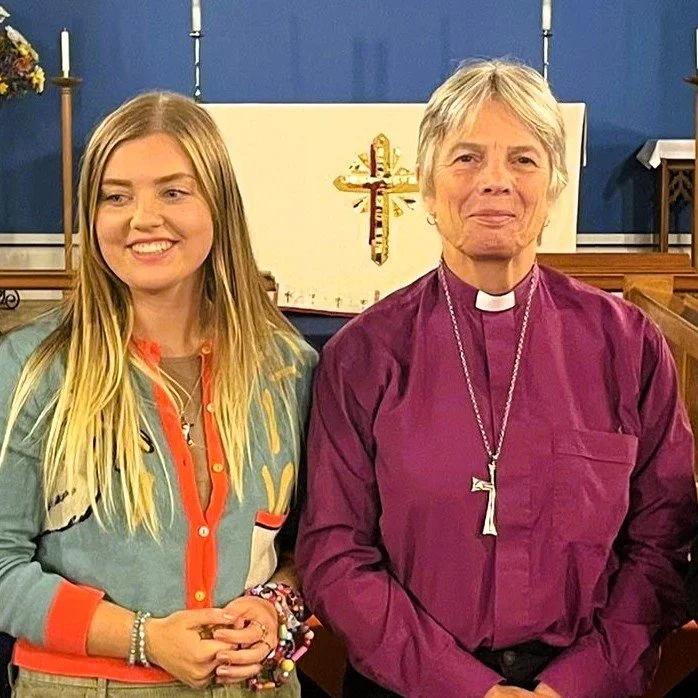
Jules with OTN Patron and Archbishop of Wales the Most Reverend Cherry Vann, who led the Confirmation service at Open Table East Cardiff.
FOR TWO YEARS I had been debating getting confirmed as a Christian, publicly affirming my faith and confirming the promises my Godparents made for me at my baptism.
Without the support of the Open Table community in East Cardiff it would have likely been at least another two years (probably longer).
But because of the unconditional love, acceptance and dedication of my Open Table family confirmation became possible.
“I didn’t have to hide being lesbian, struggling with my mental health or being autistic… confirmation and God’s love was open to me - all of me.”
For as long, and as early, as I can remember God and my faith have been incredibly important to me, but church was not. When I was a child we didn’t and couldn’t go to church as they weren’t consistently safe and accessible to my family, and my brother who I cared for with arare genetic condition. So instead I carried the messages from RE (religious education) lessons tightly; particularly ‘love thy neighbour’, and used the sole foundation of love to guide my faith.
By my teens I had rejected the mere idea of church; how could I associate myself and my faith with something that discriminated against so many of my LGBTQIA+ friends? And by my late teens/early adulthood I tried to reject my faith completely when I finally realised and accepted I was a lesbian but no matter how much I tried to push away, I kept getting drawn back to Gods unconditional love.
Soon after that I found LGBTQIA+ affirmative churches which felt like home (and not long after the Open Table community). After dedicating more time and commitment to my faith and watching others get confirmed I knew I wanted to be confirmed too. It felt hugely important to me as I dedicated and related every part of my life to my faith; from being a counsellor, young carer and friend, to how I spend my money and my ethical stance in life.
However, I knew there were multiple barriers in the standard confirmation service and these raised internal questions:
‘How could I take part in a confirmation service when you stand in front of a big congregation with your back turned towards them for large parts of the service, when the idea of going up for a blessing creates huge anxiety and body image distress?’
‘How could I take part when I regularly get overwhelmed and overstimulated as an autistic person and have to leave church services even when I’m sat hidden at the back?’
‘How could I engage in a confirmation service when part of the standard confirmation service involves families and confirmation candidate going up a couple steps to a font when that would exclude my brother in a wheelchair?’
Most of all I hated the idea of being different and needing accommodations.
But after a conversation with Mother Rose at Open Table East Cardiff, suddenly confirmation became a real possibility. I didn’t have to wait years more to have better mental health, or go back to masking being autistic, or leave my family out of confirmation. Instead confirmation and God’s love was open to me, all of me - I didn’t have to hide being lesbian, struggling wit my mental health or being autistic. It was also open to all of my family, and to other Christians who felt like they couldn’t be confirmed.
Open Table showed me that phrases like ‘God loves you’ and ‘everyone is welcome here’ are not empty phrases. Together as a community we made sure that not only would the service be as safe as possible for LGBTQIA+ people, but also for autistic and neurodivergent people, for those who struggle with their mental health by considering the impact of trauma, and people with physical and intellectual/learning disabilities. It was done with careful conversation and much of the decision making as possible was made with us candidates. The service was kept shorter and followed our usual familiar Open Table format, there was less movement and transition, sensory aspects were considered down to what was used in the Eucharist, and the service was physically accessible, small and aimed to minimise overwhelm.
But these weren’t just one off accommodations - they have been embedded into our community, and there is a commitment always to improve, and ensure God’s love can be as accessible as possible to everyone.
