Fear, faith and resilience: An LGBTQIA+ Christian speaks from Uganda
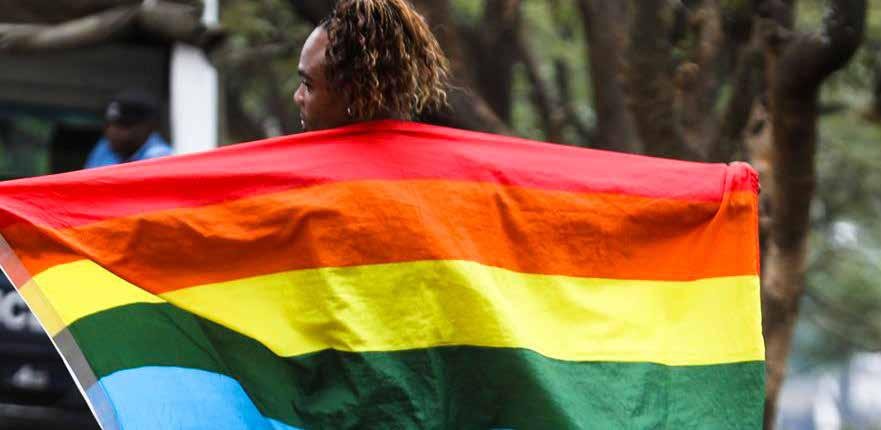
A Ugandan holding a rainbow Pride flag across their shoulders
“The church is supposed to be accepting, compassionate, welcoming, but they do not welcome you the way you are.”
Despite laws to protect us in the UK, LGBTQIA+ people still often experience prejudice, mistreatment and violence. How then do LGBTQIA+ people cope who live in countries where homosexual activity is still illegal and LGBTQIA+ people are targeted for ‘punishment’ or ‘correction’ by the state or local vigilantes?
Neil, an Open Table Network (OTN) trustee, regularly responds to cries for help emailed by LGBTQIA+ Christians around the world. While any help we can offer is necessarily limited to online pastoral care, Neil has built long-term relationships with some of these.
Ivan is an LGBTQIA+ Christian living in Uganda, where the government’s recent anti-homosexuality legislation is widely supported by Ugandan Christian groups. With Ivan’s permission, we have reproduced much of a conversation that Neil recently had with him, to discover how Ivan sustains both his faith and his hope in such challenging circumstances.
Neil:
OTN is a charity that serves LGBTQIA+ people in the UK. But our Christian faith also teaches us to show solidarity with others, which is why we wanted to speak with you and publish this interview.
Ivan:
Advocacy plays a very important role in encouraging people, because when you see other people being able to enjoy particular rights, particular aspects of life, you're able to learn from them. If they were able to do it, then actually you may also be able to do it. It may not be your time right now, but as long as you've been able to set a foundation on which you can build that resilience, then it's always a matter of time: you can get there too.
But where the challenge comes from is that religion will play its role in shaping communities. Tradition will play a role, too, in shaping the communities’ culture. Most of the cultures in Africa are not open to those rights and, in most cases, they teach people to stay conservative. I've seen that there's been quite a lot of backlash against some of the Western countries because of that conservatism.
Neil:
Can you tell us a little bit about yourself?
Ivan:
I am a university graduate, a lawyer by profession, and previously I’ve done work around empowerment at village and community levels - telling children the relevance of education, why you should stay in school, why you should take books seriously and why you should not discriminate against others, aiming to nurture them in a way that will enable them interact with all kinds of people.
Neil:
In your role as a lawyer, and as a volunteer, you’ve supported vulnerable communities, including LGBTQIA+ people. How have you done that?
Ivan:
What happens is that most LGBTQIA+ people need help, they need encouragement, they need some social skills that could enable them to survive in their communities. We hope to empower them so they are able to live within their societies, because not everyone will be able to get asylum or travel to another country. Even living within Uganda, they should be able to find ways of ‘living within the closet’ - they don't need to come out because the society in which they are living simply does not allow them to, does not really guarantee them to be able to fully express their lives.
Basically, our help would be about empowerment, teaching them how to co-exist within their communities and maybe, within the near future, they can help others around them to see that they live in a society where they can co-exist with others who are different, and enjoy their rights.
Neil:
So the kind of support people need is probably very different to what people in the West imagine. What are the main challenges for LGBTQIA+ people where you are?
Ivan:
There are three main challenges. The first challenge is the way people perceive and treat you. The community does not accept, and is not welcoming of LGBTQIA+ people, which in most cases causes stigma. You know people that you've lived with, people that you work with, people that you study with, but when the time comes that they find out that you're queer, that completely changes the way they treat you.
We are also a very religious society, and people believe the Bible is against homosexuality. So when they talk about the story of how God destroyed those cities [Sodom and Gomorrah in Genesis 19], that’s coming from a religious perspective that reinforces their perception. Then they want to associate with you even less, which causes further stigma and isolation. This leads some people into depression, while others begin to use drugs, which affects their whole life.
The second challenge is the law. You may know that Uganda has an anti-homosexuality act. It exists to punish and thus discourage homosexuality. People will be arrested, imprisoned if found guilty, though the law is not so clear about what the particular offence is. It is broad but, from the time it actually came into force, many people have been tried in courts of law. Some have been acquitted, others have been imprisoned.
The third challenge is to one’s livelihood after society has excommunicated you, or after the law has placed all these punishments on you. It becomes hard for such people to find a means of survival, or find a job. If a person is a teacher, say, it becomes hard for them to be employed in school because the parents will say, ‘This teacher will recruit our children to be homosexuals’, or ‘this teacher will influence our children’, so they are rejected. It becomes hard for people that have been outed to find jobs and other sources of livelihood.
For young people, mainly it relates to hatred, because you live in a community that does not accept you, and many of them now sadly resort to drugs, which in the long run wastes their life, which to me I don't think is the right thing. The desperation and the sense of rejection from the community leads people to drugs and to dropping out from normal society, which in turn increases the stigma and the rejection. It's a very difficult vicious circle - the rejection leads to negative behaviours which then mean you're rejected further.
Neil:
And what about churches? I get the impression that, in Uganda, religion reinforces rejection rather than providing a compassionate response to people. How do you see the church's involvement with the LGBTQIA+ community?
Ivan:
Yes, the church is supposed to be accepting, compassionate, welcoming, but they do not welcome you the way you are. The churches only want transformed people. They need people who align to what the Bible says - according to their interpretation.
The strong emphasis is that the Church disapproves of queer people. They see them as outcasts. They see homosexuality as something forbidden. Their main emphasis, when we talk about welcoming them, is to compare it, say, to someone who is a drunkard. When they come to church, what is said is that they need to be rehabilitated, so that they stop drinking and are no longer drunkards.
It's the same thing they feel should be done with queer people. They feel that they should be taken to rehab. Maybe, for example, if someone is a lesbian, they must be found a husband. And that's what they call rehabilitation! That's what the Church looks for.
And you know in churches we have Sunday school: these reflect the same thing that children hear in other schools. The Sunday school teacher will tell them stories about how queer people are bad, how they are going to go to hell. It becomes difficult for children to have an open understanding about queer people, if they even realize they exist.
Neil:
Do you find any religious spaces which offer a welcome to queer people in Uganda?
Ivan:
Yes, there are some small places, but those churches don't operate in the mainstream religious institutions. These would probably be churches that are established by a queer person. You meet people who say, we have a prayer place here, please come if you want, on a very informal level.
If you can’t find a group like that, you just have to go with other people to a normal church and pray, but still in the closet! When they say anything about queer people, it may hurt you, but you can’t show anything; after praying you just have to get up and go. The only churches that are welcoming are set up by the queer people themselves. But the Catholic church, the Anglican church and the ‘born-again’ churches don't accept this.
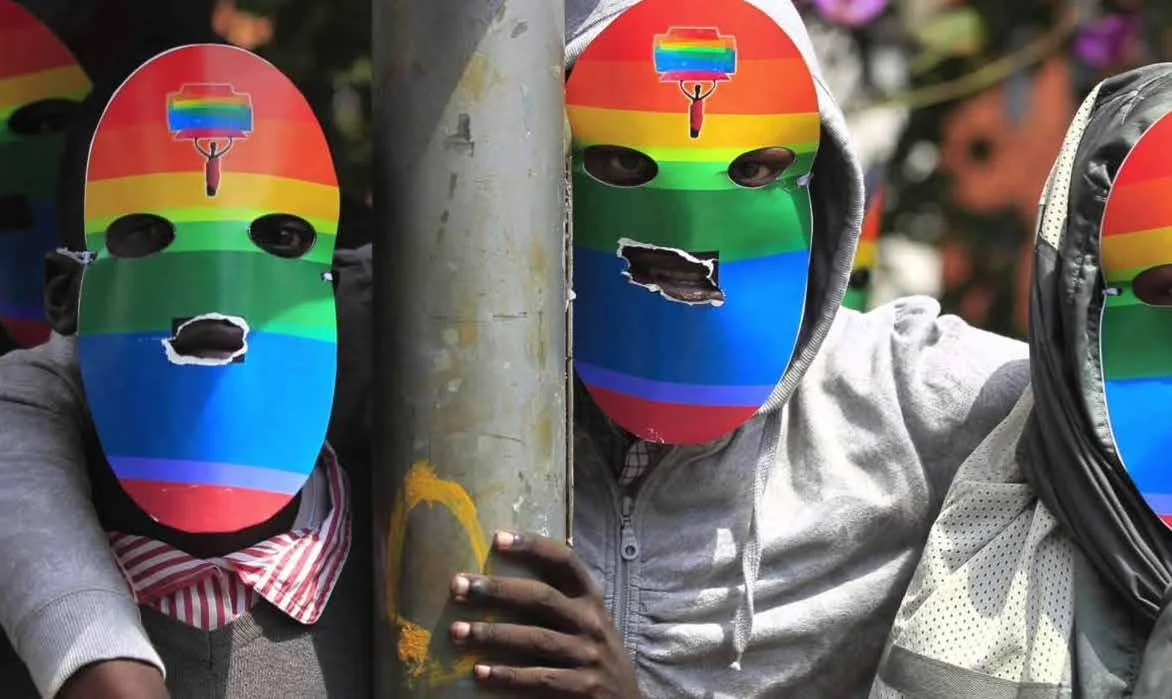
Queer Ugandans need to conceal their identity because of legal and social sanctions
Neil:
Are there other organisations or people who might be willing to give public support to the queer community?
Ivan:
Of course: we have civil society organisations, non-governmental organisations (NGOs) that offer support to queer people, such as medical care. They don't necessarily discriminate. What happens is that these organisations are registered with the aim of helping all people, even if, when it comes to their operations, they are dealing with queer people. If you try to register an NGO that deals with queer people, you won't get a licence. So you need to register it as one that is going to help the entire community.
We have some organisations that offer genuine support to people. Some even have shelters. Some offer legal aid or basic amenities to people who have been expelled from their homes. But locating them is not easy because they operate undercover, and the police are always looking out for them, closing their offices and arresting the directors.
If your support is directed to queer people alone, then it can be seen as promotion or recruitment which is an offence under the anti-homosexuality act. One of my lecturers at law school had an NGO which actually supports queer people - mainly he deals with advocacy, representing them in court. At one time, his offices were attacked by the police, closed down, and his licence was revoked. Why? Because he only offered support to queer people. The question was asked, why don’t his services go beyond to everyone in the community?
Neil:
Do you want to speak about your own experience with this? Is that something you're comfortable to talk about?
Ivan:
I was offering encouragement, advocacy, talking to these young people, and initially would always have meetings. I have been in advocacy work with queer communities since 2015, even before I joined law school.
I had somehow manoeuvred and understood the situation and how to support my fellow youth. But when the anti-homosexuality act came into force, things changed a bit. There were more prosecutions, investigations, and any suspicious activities would always be inquired into. We had a community activity that plain-clothes police came to and arrested me.
I was interrogated, charged with promotion of homosexuality and remanded in prison for five months until I could obtain bail. I still don’t see how the prosecution had evidence for this charge, as our meeting was a fellowship where each person shared their own needs, for example for help with rent, or food, and signed an attendance form.
But even so, once an offence like this has been lodged against you, your family does not want to associate with it. Your family turns their back on you. Straight marriage is a very important aspect of our community and culture, so people will keep on asking, ‘Why is this person not married?’ They feel you're betraying the culture.
And it is hard to find employment. But thankfully I am doing okay, and I believe the case will soon be withdrawn.
Neil:
You mentioned the importance of advocacy. We live in a globalised world these days, and things that are said or done in other countries can affect for better or for worse things in your own country. What do you think Christians in the UK can do, or how would you like to see the Church in the UK responding to the situation for queer people in Uganda?
Ivan:
When a position is taken by the Church in the UK, it may not really influence what happens here. But those small efforts, over time, mean a lot. The Church here itself benefits from the Church in the UK through grants and development work, so if the Church in the UK makes robust statements about protecting the rights of everyone and accepting everyone as they are, in the long run, it will have an effect on the Church in Uganda.
It may not happen today. It may not happen tomorrow. But if there is that consistent message from the Church in the UK, advocating for these rights, showing solidarity and standing with these people in a way that will influence the Church in Uganda, who knows - ten years from now, 15 years from now - the situation may begin changing.
Let's take the example of the UK parliament. When a member of parliament stands up and says something about Uganda, we receive that information: it is all over the news. I think the same thing would happen if the UK Church keeps on making these statements. Perhaps you can clearly say that, even when the Church here may not support us, you who are miles away from Uganda support us, and you know that where we are now, you have been before, and you believe that if we stay committed we’ll get to where you are now! We just need that encouragement.
Another thing is the available literature: literature available here is in line with an interpretation of the Bible, with traditions and culture which support only straight relationships. People don't have an opportunity to be exposed to something different. What I am going through today, you may have gone through ten years ago, so I am able to read your experience, learning from what you did. One thing I've realised is that information has a power that we may underestimate. If someone is able to read something on their own, they may be able to draw something from it that can help them.
Bringing the issues in Uganda to the attention of your government can also help. If the UK puts pressure on our government not to discriminate against people, there are some policy changes, some policy drifts that you will see. Because Uganda benefits from UK aid, if the UK wants Uganda to do ten things, it might do at least four, including one that talks about promoting human rights. Asking the UK government to say, ‘For us to be able to give you this aid, you need to respect the human rights of LGBTQIA+ people’, that could have an impact. We accept that human rights are progressive in nature, so whilst it might not solve everything, at least they can progress to a certain extent that is better than the current status.
Neil:
What would you like to say to Christians in the UK? What can we learn from you and others in your situation, or what lessons have you understood which can help us in the UK?
Ivan:
Firstly, be happy where you are, for every situation that you're in. Someone in the UK may complain about the difficulties there, but they don't know what's happening in Uganda.
Secondly, continuous fellowship, continuous engagement with a community, with people coming together - it means a lot. When someone shares their story, there's something that I pick up that I will use in my own life. That aspect of meeting together - it may be physically meeting or online, but it is very important.
Another lesson would be the need to hold our leaders accountable. The leaders we vote into power have an obligation to us. We have an obligation to the community, to society, to the country at large. Are we able to hold them accountable? If someone is in parliament but they are making a law that is oppressing others, is that what they are supposed to do?
I think the the USA has put some travel bans on some of the members of parliament in Uganda responsible for the anti-homosexuality bill, and if someone is restricted from travelling, maybe they will think about what they did. How can we better hold our leaders accountable?
[Editor’s note: The UK government has not officially imposed visa restrictions on Ugandan MPs due to the Anti-homosexuality Bill.]
As a lawyer, I have read a lot. I have read about revolutions, about how change happens, so I know the importance of being positive, being objective. Situations may be difficult, but they're not only difficult for me. Even for those who have had success, situations were difficult. We need resilience, objectivity and to take one step at a time: consistency and patience are very important.
Neil:
I know all you have expressed has come at considerable personal cost; this isn't just about some theory, you don't sit in a nice office telling people what they should do, but you've faced real consequences and spent time in jail because of your convictions and your willingness to support people who need that support. Thank you for your example, and thank you for your insights.
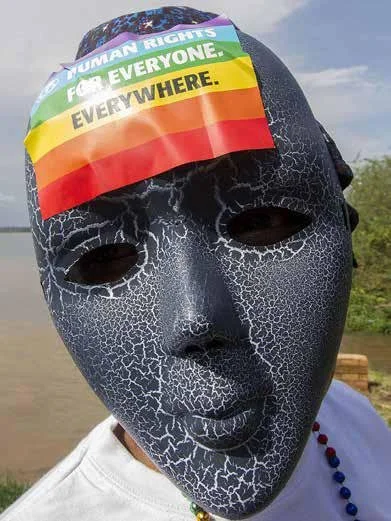
A masked Ugandan with a rainbow flag sticker showing the text ‘Human Rights For Everyone, Everywhere’ in white text.
For those who would like to understand more, we include links to a couple of resources from a magazine produced in Uganda by and for the queer community:
For current news on the situation in Uganda (and other African nations), see the Kuchu Times (kuchu is a slang word coined by the LGBTQIA+ community to refer to themselves without being explicit).
If you would like to read testimonials and the lived experience of LGBTQIA people in Uganda, you may like to download one of the latest editions of Bombastic, a magazine edited in Uganda by and for the LGBTQIA+ community:
We are grateful to Ivan for speaking with us and trust that you have found his insights and experiences helpful. No doubt there will be those of you who may also wish to respond in some way to what you have learned:
For those who would like to contact their MP to encourage a stronger response by the UK government, we offer a template letter that you can use.
Finally, if anyone would like to contribute financially towards initiatives to protect LGBTQIA people in Uganda, please contact us.
