
The kingdom of God is wider than fear
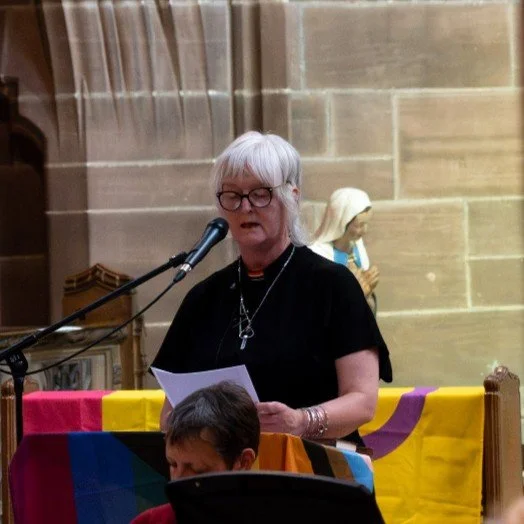
Revd Cate Jacobs preaching at the Pride service in the Lady Chapel of Liverpool Cathedral on Sunday 26 July 2026. PHOTO: Beth Powell
LAST SUNDAY, at Liverpool Cathedral's annual Pride service, Revd Cate Jacobs, a long-standing member and supporter of Open Table, reflected on Jesus' parable of the net (Matthew 13:47-51).
Speaking to a congregation of LGBTQIA+ people, friends, families and allies, Cate addressed a passage that has often been used to condemn queer people, offering instead a message of hope rooted in the expansive love of God.
“You are not an error in God’s creation, and you are never beyond the embrace of Christ.”
This parable, like many Bible verses, has frequently been used in a very hellfire-and-brimstone way to condemn us as queer people.
All the images of sorting, judgement and fire have been used to wound people. People like us, who have all too often been told by others - and I'm ashamed to say, by Christians, pastors and priests - that we are somehow outside of God's love. Many of us here today will know this experience only too well, and I am deeply sorry if that has been your experience.
I hope that here, in the Open Table community, you'll find a place of acceptance and belonging, because we are glad that you are here and acknowledge the courage it can take to just show up. So welcome.
Friends, I assure you that nothing in this passage says that being LGBT+ places a person beyond the love of God.
Nothing here teaches that queer people are the ones destined for rejection. That message has been spoken from a place of fear by those who seek to use their theological bias to support a position of prejudice. When challenged, they'll glibly say something along the lines of ‘love the sinner, not the sin’, and they'll quote verses from the Old Testament - often poorly translated and misunderstood in the first place - to back up their prejudice and condemnation, while missing the true message that Jesus preached in the Gospels.
Jesus says that the net gathers fish of every kind. That is where the parable begins: with breadth, not narrowness. With a wide gathering, not fearful gatekeeping.
The kingdom of heaven reaches out. It is not fragile. It's not threatened by human diversity. It is expansive enough to hold us all. If anything, this image should caution against assuming that anyone is qualified to sort people into worthy and unworthy.
The net belongs to God, not to those who would use toxic theology to exclude. And when Jesus speaks of the separation of the wicked from the righteous, the question is not, Who are you? but, How do you live?
Throughout the Gospels, Jesus constantly directs attention towards the fruit of life:
love, not cruelty;
mercy, not hypocrisy;
justice, not oppression;
truth, not harm.
His sharpest warning is reserved for those who burden others and shut people out. In that light, this passage is not a threat against LGBT+ people living honestly as God made us. It is a warning to all of us against hatred, arrogance and the misuse of power.
So if you have ever been told that this parable is about you, you need to hear this: you are not an error in God's creation, and you are never beyond the embrace of Christ. The fire of God's judgement is not aimed at your identity, your capacity to love or your longing to live truthfully.
What God desires is integrity, mercy and love. Those gifts are found abundantly in LGBT+ lives and relationships, just as in any others. The good news of the kingdom is not that God is searching for reasons to cast people out.
The good news is that God's love gathers us into truth, heals us from shame and calls us into lives shaped by love.
And then Jesus asks, ‘Have you understood all these things?’
Perhaps the real answer is not simply ‘Yes’, but that we understand the kingdom of God is wider than fear, deeper than prejudice and stronger than shame.
