The transformative power of belonging: What LGBTQ+ Christians can teach the wider Church
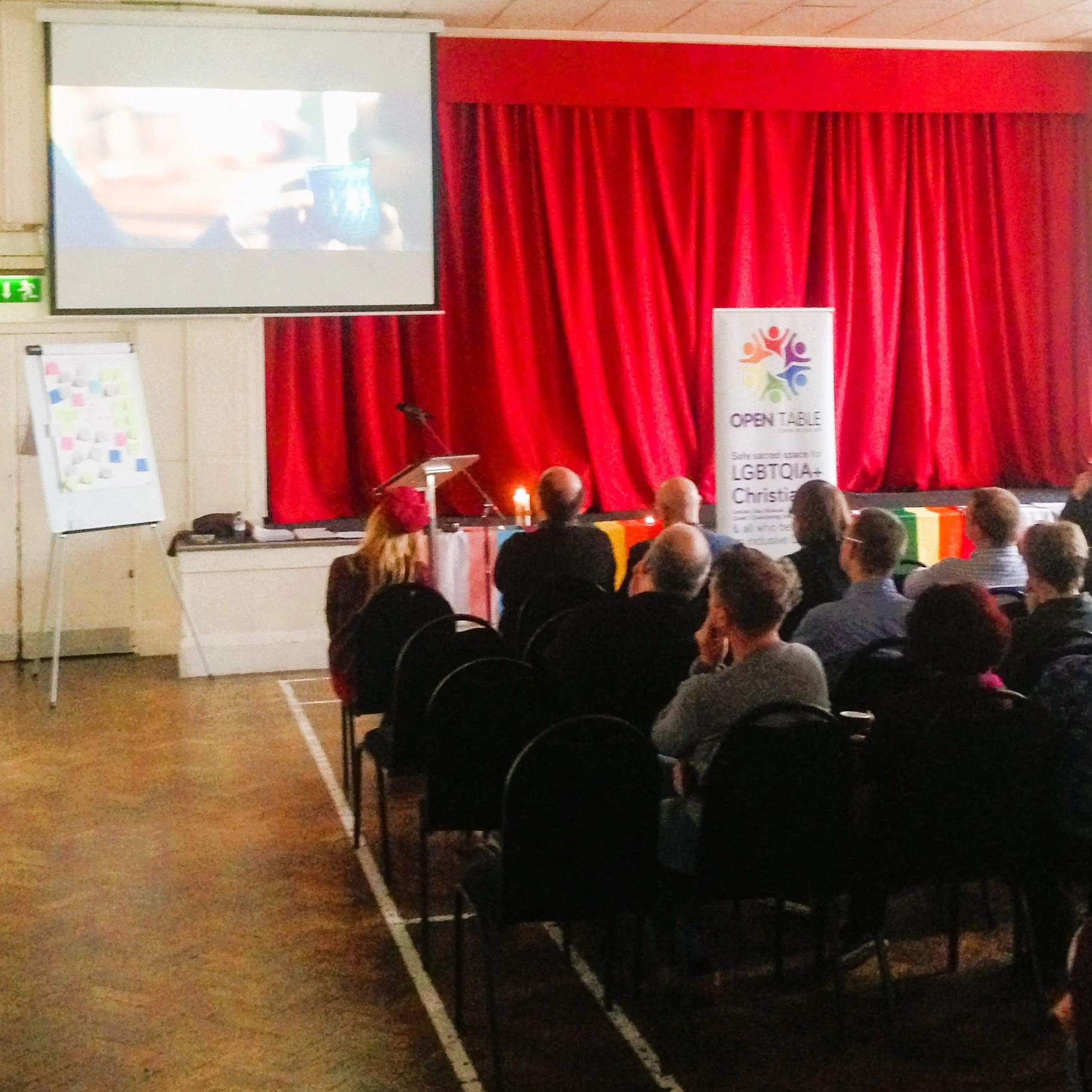
Open Table's first national gathering in October 2017, where the premiere of the short film Will It Be Open Table? marked the beginning of a transformative journey for many. WATCH HERE [3 mins].
Open Table's first national gathering in 2017 became a turning point in Dr Sharon Peters' life.
In this guest blog, she reflects on how that experience led to Master's research exploring the spiritual formation of lesbian Christians, and why LGBTQ+ stories of faith have much to teach the wider Church.
Although almost nine years have passed since Dreaming around an Open Table in October 2017, its impact on me remains as vivid as ever.
“Finding other LGBTQ+ Christians gave them language to express what they were experiencing and enabled them to believe that it was possible to integrate their faith and sexuality.”
At the time I was working as a GP and had for some time felt increasing discomfort knowing that while church attendance is a positive factor for the wellbeing of most people, it is often harmful for those who are LGBTQ+.
Around ten years ago, in an attempt to understand how churches could change, I attended a conference run by the Oasis Church Network, which left me with a desire to be able to worship and fellowship with my LGBTQ+ Christian siblings. It took me a while to find anywhere but persistent Googling eventually led me to Open Table’s national gathering - Dreaming around an Open Table.
There I had one of the most profound spiritual experiences of my life. The level of vulnerability and sharing was something I rarely experienced in other Christian spaces and the presence of Jesus in the room was tangible. I subsequently made contacts that have enabled me to worship regularly in LGBTQ+ spaces, where I have found conversations to be rich and reflective and engagement with the Bible transformative. I have found a culture of kindness and authenticity.
Years later I had the opportunity to undertake research into spiritual formation as part of a Master’s degree dissertation. At the Oasis conference I had been part of a seminar looking at the lived experience of lesbian Christians in churches. Like most LGBTQ+ Christians they had all experienced rejection and exclusion, and many were no longer attending church. As lesbian Christians they felt doubly silenced, by being both women and gay. Yet, despite the obstacles, many had a deep and meaningful faith, and so I set out to explore the factors that had enabled this.
What is Christian spiritual formation?
Christian spiritual formation is defined by Dallas Willard as:
‘the Spirit-driven process of forming the inner world of the human self in such a way that it becomes like the inner being of Christ himself’.[1]
The process is lifelong and involves integrating all aspects of a person, including their thoughts, feelings, will, body, social context and their soul (the essence of who someone is). This provides insight as to why LGBTQ+ Christians, who have been told that their sexuality or gender identity cannot be fully integrated with their Christian faith, experience such intense internal turmoil.
However, much of the literature on Christian spiritual formation and faith development refers to the transformational potential of a life decentring event; an event that produces significant internal conflict and challenges a person’s worldview. The realisation of same-sex attraction or gender dysphoria for those who are also Christian is a decentring experience as they reassess who they are in the light of Christian teaching.
This raises the possibility that as a group, LGBTQ+ Christians may be more likely to have encountered the factors that enable faith transition and growth than the many Christians who have yet to live through a paradigm changing experience.
My research[2] involved interviewing four Christian lesbians who felt love and accepted by God. Each spoke at length of their experience of faith and sexuality; it was a deeply moving experience for both me and my participants. They had each been through deeply difficult times but had all also been through a profound and life changing encounter with God. Initially they felt trapped in a life that felt inauthentic:
‘It always felt like I had to be a slightly different person, it really played into that whole shame thing.’
They all endured years of extreme mental distress which eventually led to a crisis point:
‘I was trying to fit in that old life, and it was killing me.’
‘I felt like I couldn’t breathe properly and that I didn’t have a choice.’
‘It’s as if my psyche was overwhelmed.’
One of the women, reflecting on their faith, realised she had absorbed
‘all these different ideas about what it means… and just accepted everything… without any sort of interrogation of it.’
Another realised:
‘[I was using] faith as a bit of a smokescreen, and a hiding place... I was highly judgemental of myself.’
It was only on reaching a crisis point that they stopped trying to live up to the expectation of others:
‘Where I’ve got to with my faith is that it’s so incredible… there is no experience that I have that is unknown to Jesus… it’s given me a way of understanding acceptance that I don’t think I’d have had otherwise.’
‘All my life I’d been “in”, I’d been on the inside… a good Christian girl. Suddenly I was catapulted to the edges, and I thought I don’t recognise this place… And suddenly, the Jesus who was going to the outsiders, the ones that were outcast, the rejected, that’s where I was… and it was an amazing experience… I wouldn’t change that for anything, for my experience of God now. Being thrown to the edges and seeing God from this place is seeing God as love and that’s the difference.’
The study looked at the factors that enabled the women to integrate their faith and sexuality. All had spiritual encounters that led to a strong sense of God being present throughout the process, leading to a desire to resolve the mental distress within a faith context:
‘I recognised God’s touch on my life, all through my life, to that coming out time.
‘There were occasions when I would just be flooded, flooded with God’s peace and love.’
Finding other LGBTQ+ Christians gave them language to express what they were experiencing and enabled them to believe that it was possible to integrate their faith and sexuality. As well as creating space for the participants to heal and grow, one of the most powerful ways that other Christians, especially those in leadership, enabled the faith journeys of the participants was by their willingness to be vulnerable themselves and publicly own their affirmation of LGBTQ+ Christians – in the words of one participant, Christians
‘who have got no vested interest in this apart from wanting to live by the truth as it were.’
Although the trauma of their experiences never entirely resolved, the participants each found ways of handling with integrity the negative reaction of others, including when reconciliation with those who had hurt them was not possible and often not advisable:
‘I can’t deny it still hurts, but [I’ve] found a new way of being.’
‘I can’t control whether people want to exclude me or not, but I can control whether I want to include them or not. And actually, love included me, which is amazing.’
‘I left four pages [blank] in my journal at that time. I couldn’t write it down, what they did and said… but the healing has come… we just kept going back and kept forgiving them.’
‘You can choose to exclude them… you can choose to collapse them into this collection of stereotypes, attitudes… or you can be like that’s another person… working out their own stuff.’
Being able to voice their experience was key to the women being enabled to feel God’s love and acceptance, to finding light in the darkness. The Psalms speak of this process of lament, and the study concludes that Christian communities should learn to lament with lesbian (and other LGBTQ+) Christians, acknowledging their experience of exclusion and allowing them to share their faith stories. People who have suffered need to come to their own understanding of what has happened if they are to integrate their experience into the fabric of their lives.
It seems Christian communities often inhibit spiritual formation rather than facilitate it, failing to embrace the mutual learning that might occur. The experience of faith described by many LGBTQ+ Christians gives a vivid portrayal of spiritual formation which, if shared more widely, could enable others (LGBTQ+ or not) to better understand their own spiritual journey. This has certainly been my experience, with Open Table being a significant part of that.
LGBTQ+ stories of faith have the potential to be an encouragement to the wider faith community to trust in the faithfulness of God through the process of listening to each other, rather than trying to predetermine the outcome.
Notes:
[1]. Willard, D. (2021) Renovation of the Heart: Putting on the Character of Christ. (20th anniversary edn). [Kindle version]. London: NavPress.
[2]. Peters, S. (2026) From disorientation to new orientation: an interpretative phenomenological analysis of the aspects of spiritual formation that enable lesbian Christians to feel God’s love and acceptance.Practical Theology, 1-12. doi.org/10.1080/1756073X.2026.2636339
