
When everything is shaken, what remains?
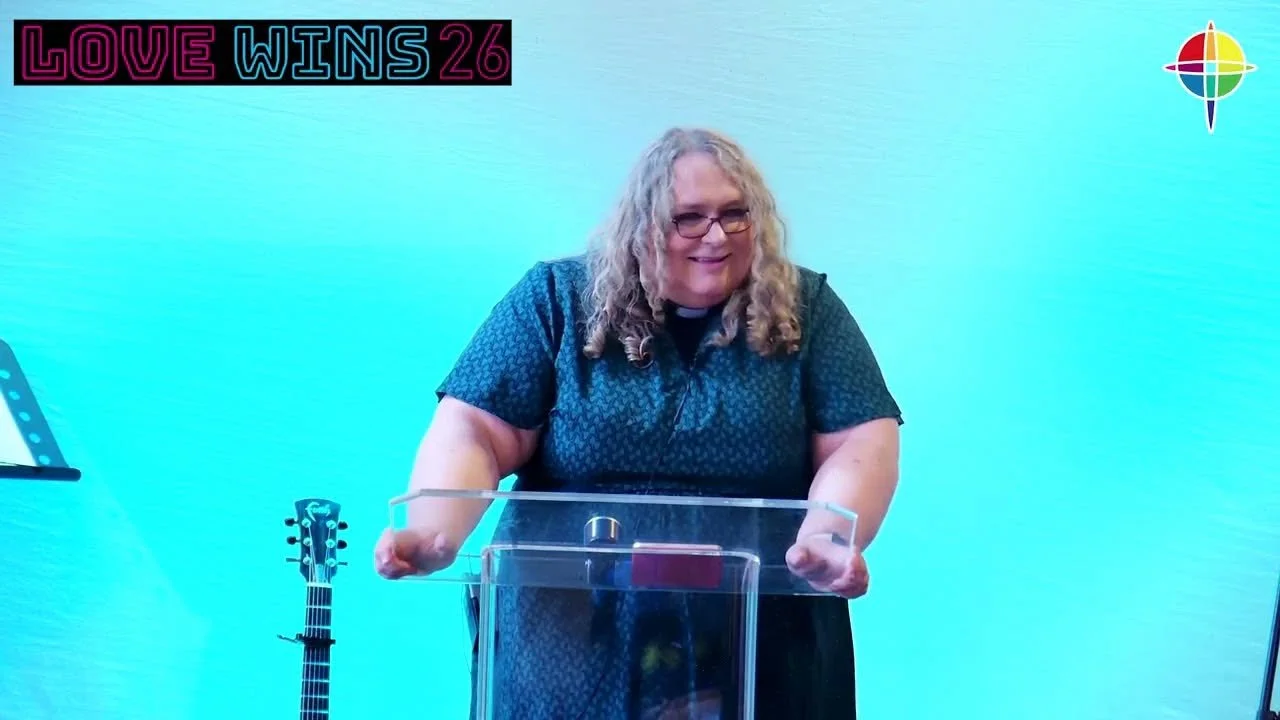
Rev Sarah Hobbs speaking at the Love Wins 2026 conference.
“Cruelty does not become God’s voice simply because someone uses religious language.”
LAST MONTH, former Open Table Network Co-Chair Sarah Hobbs spoke at a conference and received online hostility.
Sarah, now a deacon in the Church of England Diocese of Leeds, preached this sermon inspired by Hebrews 12:18-29 at the Open Table Northallerton community this week, on how an internet pile-on transformed into an experience of overwhelming love, support and renewed connection with God.
During their travels, the Israelites encountered God at Mount Sinai amid fire, darkness and overwhelming holiness. Even Moses trembled with fear. The letter to the Hebrews contrasts that terrifying scene with the joyful gathering at Mount Zion, the heavenly city, where through Jesus we are welcomed into God’s presence.
At Sinai, God made the earth tremble. The writer of Hebrews recalls God’s promise that once more he will shake not only earth but also heaven. This is a much bigger picture than the difficulties of our individual lives. It is about God removing what cannot endure, so that what cannot be shaken may remain. But it also gives us a question to ask when our own lives become unsettled: when the things we thought were secure begin to give way, what remains?
I don’t want to suggest that God is cruel, or that he arranges painful experiences simply to teach us to rely on him. But I do think that when things come into our lives that shake us, God can meet us there and help us recognise something we hadn’t seen before.
I don’t know whether this is true for you, but sometimes I get complacent. I have a routine, a comfort zone, and I don’t particularly want to be shifted out of it. That might sound surprising because I also get bored quite easily and like to mix things up. I always say to people - and it is true - that I am a little bit of a change addict.
I will go into a situation and think, ‘This could be better in some way.’ But there are definitely things wrapped up in cotton wool about which I would say, ‘God, you can shake that, you can change this, but that thing? That’s off limits. You are not going near that one.’
And if you do, rather than being excited about change, I’m going to shake my finger at you and have a full-on diva strop!
Some of you, particularly those familiar with my babbling on Facebook, know that recently I experienced something we might call an ‘unwelcome shaking’.
Here, I know that I am loved and cared for, but outside this context my personal story isn’t without controversy in the Church. Not just because I am transgender, but because, as people have been pointing out online, I am also a member of the clergy.
A few weeks ago, I was invited to tell my story and explore some theology at a conference in Keighley called Love Wins. I was brutally honest. I talked about my journey of how I understand being transgender through the Bible, and I was at pains to invite people to weigh my points, not just to listen to me and to seek the truth for themselves.
They were a wonderfully hospitable group who made me feel safe and welcomed. The talk went online afterwards, and initially it was sunshine and roses: warm affirmation and kind words from people who said they had been deeply affected by my honesty. So far, so brilliant.
Then I wondered whether the talk had been shared more widely. And it was then that the world shook.
I discovered that some less than supportive Christians had edited the forty-minute video down to a selective three minutes. They then misrepresented what I had said. Instead of my reflection on Jesus’ words about a father giving his son bread rather than stones, they claimed I had said that being transgender was the bread of life.
This started what is called, in internet terms, a pile-on.
Fortunately, the posts named me without linking to my account, so I discovered them rather than being inundated with messages. But hundreds of people had been criticising my theology, my calling, my relationship with God and my family, and my appearance.
It hurt.
I tend to think of myself as reasonably thick-skinned, but this knocked me. As a recently ordained member of the clergy, I would like to tell you that my first reaction was to throw myself on God. Instead, I felt my heart break.
For a few days I tried to get on with life, but the sadness followed me around. Eventually, I decided to share what had happened with my friends on Facebook. One friend has described this sort of thing as a ‘holy moan’, and perhaps that is what it was. But asking for support turned out to be part of finding my way back into prayer.
Something truly amazing happened.
My friends lifted me up. They told me what they thought of me, and their kindness came like a wave. They didn’t just say, ‘There, there.’ They replaced the words of the trolls with new words: words that filled me with hope and gratitude.
And I realised - not in a boastful way - just how deeply I am loved.
I went to Open Table Bradford too, where the love continued.
On the way home, the dam finally broke. I prayed and cried, and prayed and cried, and felt connected once more with God.
What happened still hurt, but I began to recognise what had remained through it all: the love of my friends, the welcome of this community, and the faithfulness of God.
When we are shaken, it can be easy to confuse God with the shaking. We might blame God, or mistake the people claiming to speak for God as an accurate reflection of his heart.
But cruelty does not become God’s voice simply because someone uses religious language.
The people who speak about God are not themselves God, and their approval is not the foundation of his kingdom.
I believe I will walk closer to God because of the love that met me in this experience, particularly through the people I have the absolute good fortune of being connected to - I think, by God.
Their kindness helped me hear something beyond the accusations.
Hebrews tells us that we are receiving a kingdom that cannot be shaken. Our place in that kingdom rests on Jesus, and someone else’s contempt cannot overturn his faithfulness.
That gives me reason for gratitude, and for the reverence and awe with which this passage calls us to worship.
You may still be in the middle of your own shaking.
You may not feel grateful, or have found the words to pray, and I don’t want to hurry you past that pain. But you can be shaken and still belong to a kingdom that cannot be shaken.
Whatever is shaking in your life, you do not have to carry it alone. You don’t have to tell your story publicly. Whatever you are carrying, you are welcome to bring it to Open Table.
If this reflection has touched something in your own life, we hope it might be an invitation to pause, to pray, and perhaps to find the people who can remind you of what remains when everything else feels uncertain.
